quality(100)format(avif))
Work gloves: selection guide and European regulations/standards
When to use work gloves and safety gloves?
format(avif))
Hands are one of the parts of the body most at risk of possible accidents. Statistics show that one-third of work-related injuries involve the upper limbs and hands.
This is an important statistic that raises awareness among companies and professionals about the proper use of work gloves and greater attention to safety at work.
But how to choose work gloves?
In this article we will try to shed light on the European Regulation/standard and how to read the markings on gloves to recognize the degree of protection of different types of PPE gloves.
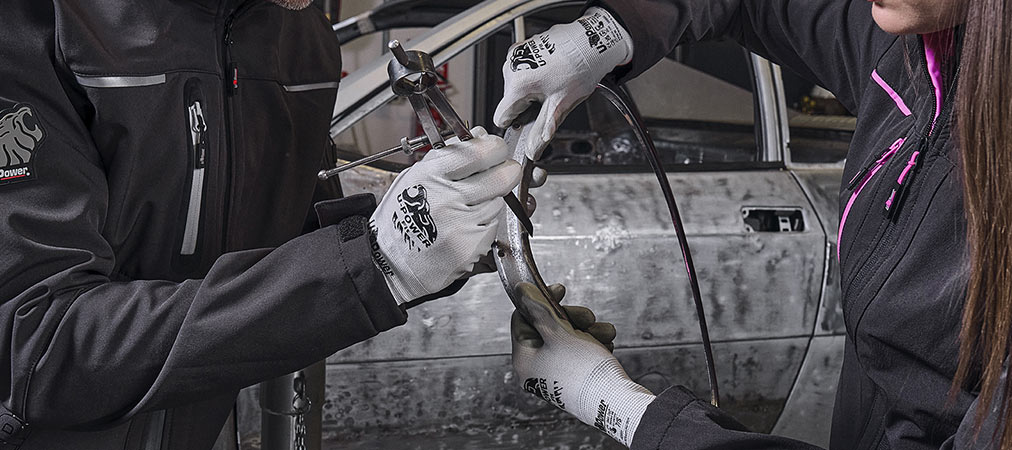
The market offers different types of work gloves and accident prevention gloves, how to understand which ones are best suited to your work needs?
Work gloves are personal protective equipment necessary whenever, during the performance of their duties, the worker has to deal with risky situations.
The European Regulations/standards present a precise subdivision of risk situations and the degree of protection required for accident-prevention gloves with corresponding classification.
Let's see together how to distinguish between the different cases.
Let's see more in detail!

Hands are used in all activities of human life and, in the work environment, it is essential to protect them from physical (mechanical, thermal and electrical), chemical and biological hazards.
Safety gloves are classified as PPE and must meet strict national and international regulations/standards that aim to ensure the safety of the worker and also the employer.
There are different types of work gloves that differ greatly in material and degree of protection.
The first distinction to be made is, therefore, the level of risk:
LEVEL 1 - MINOR RISKS
Low-risk situations where a basic, simple and comfortable protective glove is sufficient.
LEVEL 2 - INTERMEDIATE RISKS
Situations where there is a real risk of cut, laceration, perforation or abrasion. In this case, a PPE glove that meets specific regulations/standards and must bear the reference marking is required.
LEVEL 3 - IRREVERSIBLE RISKS
Situations with a high risk of serious hand injury due to handling and working environment. CE marking and recognition code in the marking is required.
The standard that establishes the general requirements for work gloves is EN 420. This provision does not define the level of protection of the glove, but provides general guidance on use, ergonomics, safety and marking.
Levels of protection for work gloves are defined by specific standards according to the risk under consideration including:
EN 374
Protective gloves against chemicals and microorganisms for which penetration and permeation tests are required to prevent the skin from coming into contact with toxic substances to ensure a true protective barrier.
Protective gloves against mechanical hazards associated with the use of a machine or tool that must provide safety against abrasion, cuts, tears and punctures.
Protective gloves against thermal hazards and heat. These gloves are tested for resistance against contact, convective and radiant heat, flame spread and contact with small amounts of molten metal.
EN 12477
Protective gloves for welding that also ensure a high degree of dexterity and precision of finger and hand movements.
EN 511
Protective gloves for cold weather. They offer different levels of convective and contact cold resistance, as well as water proofing.
EN 1149
Antistatic gloves with electrostatic properties to prevent dangerous electrical discharges.
Let's now look at how to choose work gloves based on the scope of use and the actual risks encountered while performing tasks
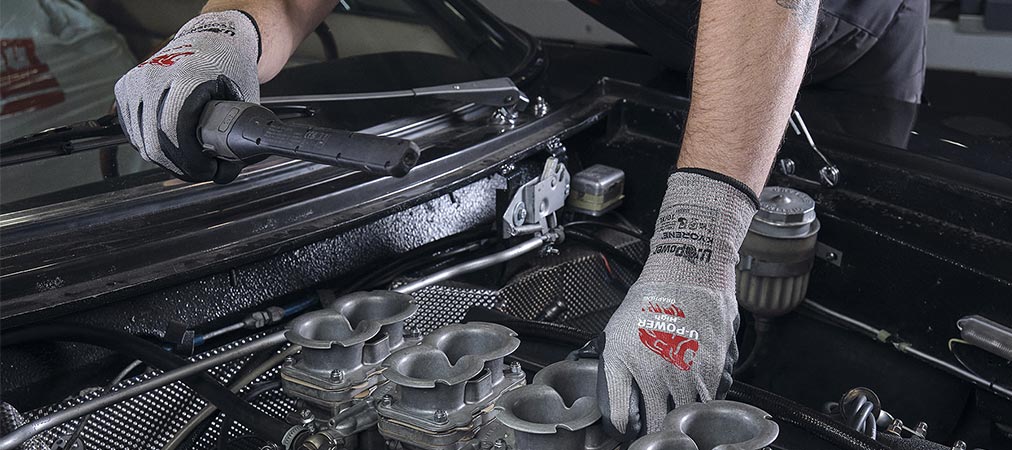
The choice of work gloves must start with an assessment of the risks present in the workplace and the type of task the worker performs.
Within the same company, therefore, different types of gloves may be used: for example, protective gloves against physical risks and gloves against thermal or chemical risks, and so on.
The second parameter concerns the characteristics of the glove, the degree of comfort, dexterity-that is, the ability to manipulate and ease in performing agile movements-,ergonomics and fit, sensitivity, and the materials used in order to avoid risks of allergies or reactions on the skin.
Let's take a few more specific examples!
CONSTRUCTION SITE GLOVES
Construction site gloves fall, except in special cases, among the second level personal protective equipment (intermediate risks) and, depending on the type of work to be performed, can protect against:
Thermal and cold hazards;
Mechanical hazards;
Cutting hazards;
Electrostatic discharges;
Chemical risk;
Radiation risk and radioactivity contamination.
Protective features are shown by their respective pictograms followed by a series of numbers indicating performance levels related to specific protective qualities.
The U-Power Gloves range/assortment offers five different styles of gloves for protection against mechanical and thermal hazards with varying degrees of fineness.
CUT-RESISTANT GLOVES FOR GLASS HANDLING
When working with glass, the main risks are heat and the danger of cuts, wounds and lacerations. PPE gloves provide protection and improve grip on delicate objects.
By using protective gloves suitable for precision handling, risks of falls and injuries can be reduced, with an overall cost-saving effect.
For glass processors, U-Power recommends the HIGH style, a cut-resistant B glove with graphene padding that provides smart thermoregulation, antimicrobial properties, odor control and fineness grade 13.
WAREHOUSE AND PACKING GLOVES
The main feature of safety gloves for those who handle packages or must pack goods is versatility. The material used for the palm must provide a secure grip, while the upper part must ensure abrasion resistance.
U-Power 's Flex style work gloves, available in Yellow Fluo and Grey, are touch screen gloves with an excellent fit and maximum grip to ensure smooth movements and handling. They are the ideal gloves for logistics due to their high sensitivity(fineness 15) and dexteritylevel (level 5).
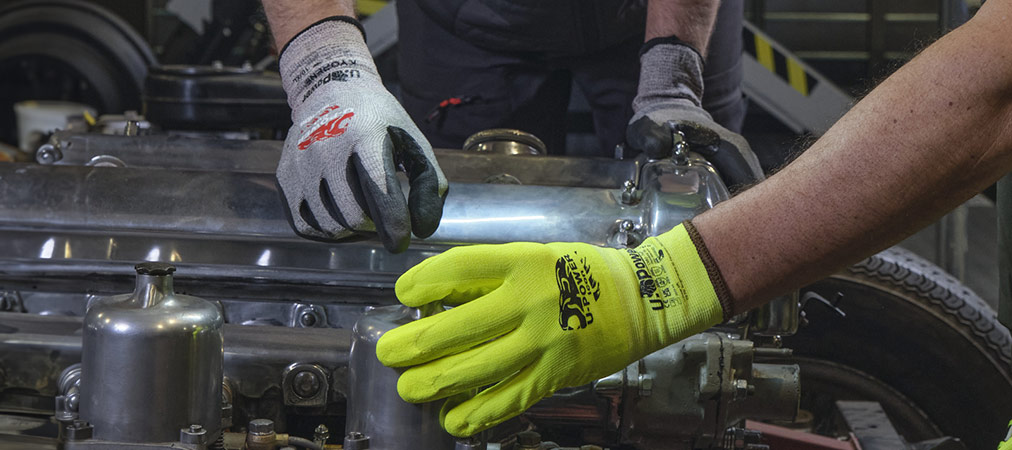
Protective gloves are the best way to avoid hand injuries during work. It is proven that most cases of hand injuries are related to non-use or incorrect use of safety gloves.
The choice of gloves should be carefully considered with the help of a company expert who identifies the various risks to which workers are subjected in the performance of various tasks. Depending on the type of operation to be performed, it is always a good idea to use gloves by changing them according to theactivity to be performed and the degree of protection required.
Once the risks have been defined, the choice must take into account the quality of the materials and comfort to enable the worker to work in the best possible conditions in terms of perceived comfort, handling and sensitivity (level of dexterity and finesse).
Accident Prevention Gloves carry a marking on the back that provides accurate information, along with the CE mark that guarantees compliance with European regulations/standards and passing the tests required by specific regulations.
Finally, the devices must be accompanied by instructions and information contained in the packaging so that users can make the correct assessments before wearing them and consider all instructions for use (e.g., avoid contact with...; replace gloves in case of...; etc.).
Read our previous article to get a complete overview of U-Power gloves and see firsthand the quality ofU-Power Gloves .
Don't Worry, be happy...with U-Power!
format(avif)) NewsSeptember 08, 2026
NewsSeptember 08, 2026Stronger together: U-Power acquires KÜBLER, combining their expertise for further growth in Europe
format(avif)) NewsSeptember 07, 2026
NewsSeptember 07, 2026Eugenio Cecchin is the new CEO of U-Power. Franco Uzzeni remains Chairman of the Group
format(avif))
 NewsMarch 11, 2026
NewsMarch 11, 2026U-Power presents Red Stratos with Ronaldinho: when safety becomes… Stratospheric
format(avif)) NewsJanuary 14, 2026
NewsJanuary 14, 2026U‑POWER GROUP SPA confirms the EcoVadis Gold Medal 2025 and ranks among the top 5% worldwide for ESG performance
format(avif)) NewsDecember 12, 2025
NewsDecember 12, 2025Franco Uzzeni presents the "Best Performance of the Year" award to Lautaro Martínez at the Gazzetta Sports Awards 2025
quality(80)format(avif))
quality(80)format(avif))
quality(80)format(avif))