quality(100)format(avif))
What tests do u‑power safety shoes have to pass?
Tests to certify safety footwear
format(avif))
The safety tests of safety shoes
A safety shoe must protect the wearer's foot from impact and also avoid, as far as possible, accidents such as slipping or electrocution. To ensure these characteristics, tests must be done, which are established by international laws and regulations and must be carried out in specialized laboratories.
U-Power relies for these tests on three accredited bodies, CIMAC, RICOTEST and CTC, to carry out the tests we will discuss in this article on all its safety footwear.
In this way, U-Power offers professionals working in the field, in every industry, work shoes that are safe from all points of view.
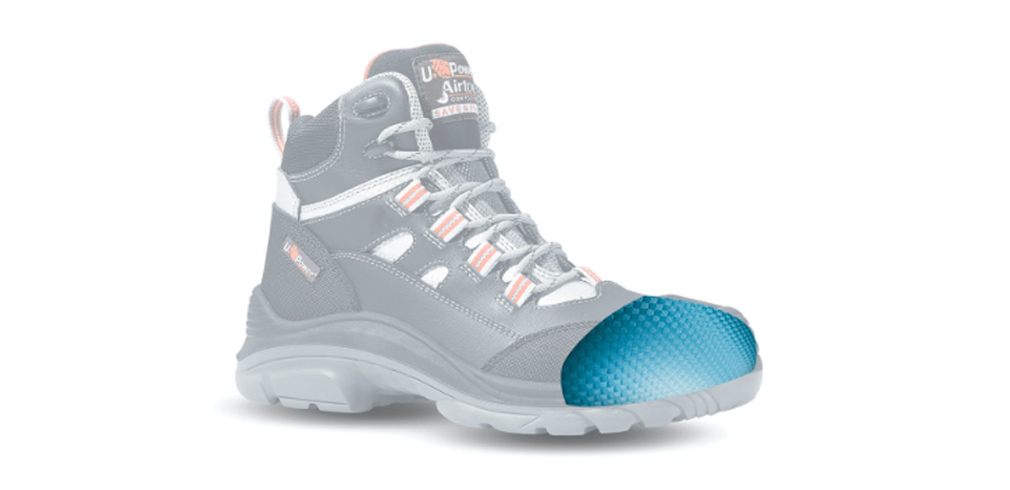
There are four tests that safety shoes must pass in order to be sold by U-Power:toe impact, toe compression, slip test, and dissipative capacity.
The first two are used to ensure that the metal toe cap inserted in a safety shoe is able to protect the foot both in the event of an impact, such as a weight falling on the shoe, and to slow compression under a press. The third, on the other hand, ensures that the sole does not lose grip even on slippery surfaces, such as are sometimes encountered in work environments.
Finally, the test on dissipative capacity concerns the property of the safety shoe to be antistatic and thus not risk producing sparks that could lead to risks of different kinds, including electrocution or fire hazards.
Let's look at the different tests in detail.
The metal toe cap of work shoes is used to protect the foot, so it must be ensured that when it bends due to impact or slow crushing, it does not deform so much that it hits the foot.
For this reason, the impact test and the slow crush test are considered passed if, at the end of the crush, at least 21 mm of foot clearance remains on the bare toe box (i.e., not inserted into the shoe) that will go into a size 42 shoe.
In the impact test on the toe box, a weight of 20 kg is dropped from aheight of 1 meter, while in the crushing test, a force of 15,000 Newtons (i.e., a weight of almost 1,500 kg) is slowly applied. In both cases, as we have said, we then measure the space that remains free for the foot after the toe box has bent.
The same tests are then repeated on the complete safety shoe and, at this point, the space that must remain free for the foot must be at least 14 mm.
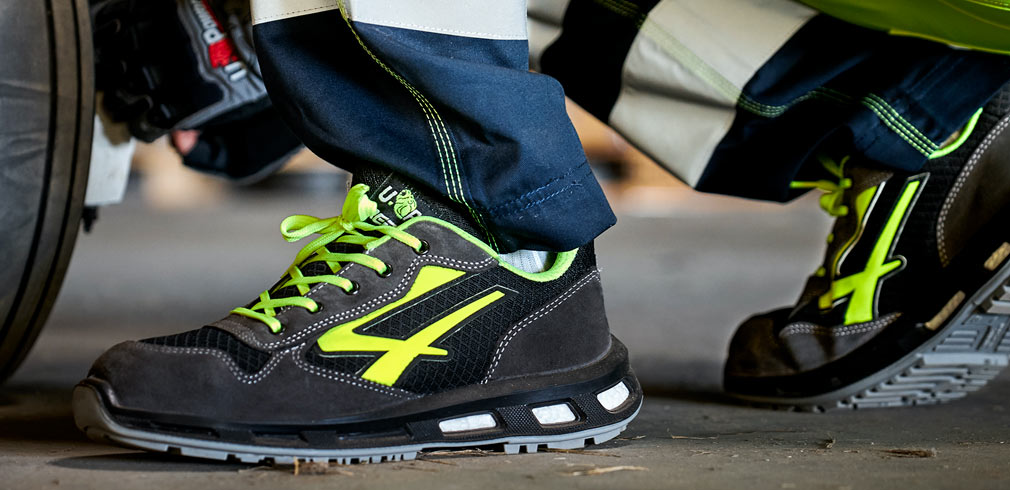
How often does it happen for those who work indoors or outdoors to find themselves on a slippery surface? Work shoes with soles that ensure they can be ben stable and not slip, perhaps even injure themselves, are needed in these situations.
There is a specific test that U-Power has its specialized laboratories do precisely to give you confidence that our shoes will not slip even in very difficult conditions. Here is how it is done.
Two test surfaces are prepared, one made of ceramic wet with a floor cleaner and another made of steel sprinkled with glycerin. In both of these cases the shoe must not slip, especially on the heel, and the test is done both with the surfaces level and at a 7-degree angle, for added safety.
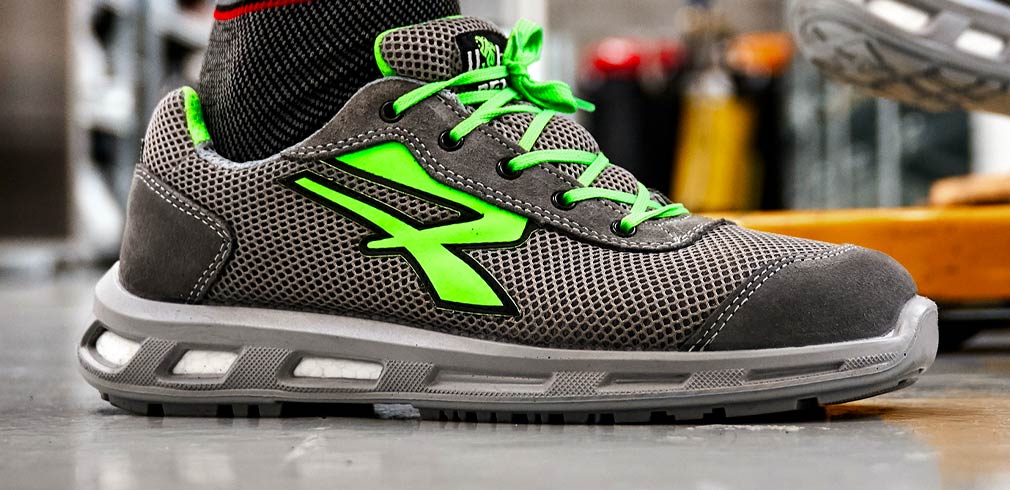
A work shoe must not spark when it rubs against any surface and under any condition. This avoids very serious dangers such as electrocution andgas fires, and, more simply, we do not risk ruining electrical or electronic circuits with a spark that started from our footwear.
It is said, therefore, that the sole of our safety shoes must be antistatic and therefore not accumulate electrical charges on itself. To be sure of this property of the whole shoe, and not just the sole, the testing laboratories that U-Power relies on measure the electrical resistance of all parts of our safety shoes and check that they stand between 100,000 and 1 billion Ohms.
Of course, there is an international standard on anti-static footwear that has established these values and how this test, as well as all the others, is done.
You should know, then, that we at U-Power do these stress tests on all our ranges/assortments of shoes as soon as we put them on sale and that we repeat them every 5 years, as is required by the standards.
Our commitment to your safety, however, doesn't stop with the mandatory tests on work shoes, but we asked Dr. Michele Montagna, who specializes in the study of human movement, to do other specific tests. In particular, Michele Montagna tested our shoes to see if they helped avoid muscle and back pain, depending on the different types of work, more static or more dynamic. The results proved that our safety shoes are not only safe, but are also able to make us feel less tired after a day's work and not give us back and muscle pain.
U-Power: your test-proof work shoes!
format(avif)) NewsSeptember 08, 2026
NewsSeptember 08, 2026Stronger together: U-Power acquires KÜBLER, combining their expertise for further growth in Europe
format(avif)) NewsSeptember 07, 2026
NewsSeptember 07, 2026Eugenio Cecchin is the new CEO of U-Power. Franco Uzzeni remains Chairman of the Group
format(avif))
 NewsMarch 11, 2026
NewsMarch 11, 2026U-Power presents Red Stratos with Ronaldinho: when safety becomes… Stratospheric
format(avif)) NewsJanuary 14, 2026
NewsJanuary 14, 2026U‑POWER GROUP SPA confirms the EcoVadis Gold Medal 2025 and ranks among the top 5% worldwide for ESG performance
format(avif)) NewsDecember 12, 2025
NewsDecember 12, 2025Franco Uzzeni presents the "Best Performance of the Year" award to Lautaro Martínez at the Gazzetta Sports Awards 2025
quality(80)format(avif))
quality(80)format(avif))
quality(80)format(avif))