quality(100)format(avif))
Work: prevention of musculoskeletal disorders
How to prevent occupational diseases: Dr. Michele Montagna's exercise guide for U‑Power
format(avif))
Very often, when we return home after a day of work, we experience recurring discomfort that compromises our well-being.
These ailments can be caused by numerous factors, not the least of which are body movements during the workday, taking up unnatural postures for many hours, or handling heavy loads.
When one considers the high frequency of work-related musculoskeletal disorders, one understands how important it is to pay attention to the risks to which the musculoskeletal system is subjected, including through the use of personal protective equipment appropriate to one's duties and the dynamism of one's work.
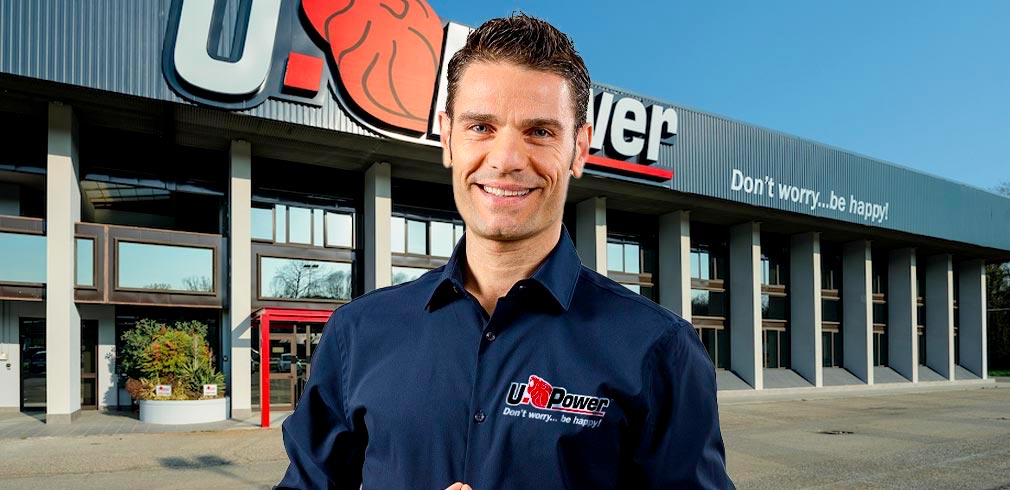
With a view to preventing occupational diseases, U-POWER has subjected its work shoes and workwear ranges/assortments to additional tests conducted by Dr. Michele Montagna, a true expert in the field:
Doctor of Exercise Science;
Kinesiologist recognized by theNational Union of Kinesiologists;
Consultant and lecturer in Work Ergonomics, Prevention and Treatment of Musculoskeletal Disorders at Work;
Certified Trainer of Occupational Health and Safety.
Today, U-POWER brings you another useful tool for the prevention and treatment of musculoskeletal disorders at work: a guide of targeted global and analytical stretching exercises prepared by Dr. Michele Montagna.
We have seen in some previous articles how technological innovations-applied to safety footwear-can help us prevent this type of disorder, viz:
Infinergy® technology in the case of dynamic work;
Red Carpet technology in the case of static work;
High Rebound technology in the case of a mixed situation.
In general, it can be said that all the exercises proposed in this downloadable guide have the positive effect of reducing muscle tension and stress but, for sure, correct breathing is the most important element to have an immediate general relaxation.
Breathing is as natural as breathing can be for humans , and it is through it that we get oxygen and energy. This physiological act is possible thanks to the diaphragm, the muscle located under the lungs and dividing the thoracic cavity from the abdominal cavity.
Over the years, we tend to stiffen up and lose our natural elasticity. The diaphragm, therefore, tends to go into almost permanent fixation, affecting circulatory, digestive, urological/gynecological functions, etc.
Try doing this exercise for at least 9 to 15 minutes, following the directions in the downloadable guide, to regain elasticity:
1ST STEP.
Inhale with your nose and exhale with your mouth with slightly cleft lips making a prolonged "sccccsssssss" sound.
Inhaling inflate only the belly and do not lift the chest to avoid unnecessarily contracting the back muscles.
Imagine two tennis balls one of which is on your chest and the other on your belly button. When you inhale ideally make this second ball rise on your belly but before you feel it also raise your chest (the imaginary ball) start to exhale.
Repeat the exercise for at least 3 minutes: if you do it correctly you will be ready for the next phase.
2ND STAGE.
Repeat the previous exercise, trying, however, this time, to exhale deeply to encourage diaphragmatic relaxation with a prolonged "scscscscsc" and you will see that with the exercise, the exhalation time will become longer and longer.
Repeat the exercise from 3 minutes and up; by sticking to the directions, you will not be able to do without it because of the favorable effects you will notice, and you will be ready for the next phase.
PHASE 3.
Now position yourself supine with legs outstretched and repeat the previous exercise, prolonging the blowing.
Repeat the exercise from 3 to 6 minutes onwards.
By correctly performing the techniques set out you will have entered the phase that will allow you to unblock your diaphragm and reduce the prime tension in your back.
All the exercises proposed in the U-POWER guide by Dr. Michele Montagna help improve blood circulation becausephysical activity-even if moderate-acts positively, reactivating it.
Try doing this simple exercise lasting 1/3 minute per leg by carefully following the directions in the guide itself.
Inside the guide you will also find supporting pictures for proper execution:
Exercise No. 3 in the downloadable guide - THIGH DISTENSION.
Stand upright, in mono-podal support with your back erect and looking forward.
Slightly bend the leg in support and flex the other by grasping the back of the foot or forefoot preferably with the ipsilateral hand (flexed right leg grasped with the right hand and vice versa with the left, successively).
Use your hand, on the side from the supporting leg, to hold on to the wall or a chair and begin to draw the heel of the flexed leg toward the buttock, keeping the leg aligned with the thigh, and breathe as you learned in theprevious exercise.
The aim is to stretch the front muscles of the thigh, and as the seconds pass, gradually increase the pull until you feel the tension give way before pulling further.
When you have some experience perform the exercise with the supporting leg extended, rather than bent; avoid this expedient if you feel that the supporting knee does not give you confidence.
At the end of the exercise repeat with the other leg.
Always remember to breathe and maintain an imaginary straight range/assortment that passes through the torso and thigh to be treated; also during the exercise be careful to pull the leg without lifting the pelvis posteriorly, into lumbar hyperlordosis.
In Dr. Michele Montagna 's U-POWER guide you can find several exercises that can reduce leg muscle pain, heaviness and sciatica problems.
While keeping in mind that all exercises should always be performed scrupulously by following the directions carefully and helping yourself with the pictures for proper execution, try doing this exercise lasting 1/3 minute per leg.
Exercise No. 4 in the downloadable guide- BACK DISTENSION
Lie on the floor with one leg extended and the foot with the sole against the wall (the ankle at a 90° angle) and perfectly perpendicular (toes looking toward the ceiling).
Flex the other leg to your chest and resting your hands on your knee, gradually pull it toward you while the ankle of the foot above can remain relaxed.
Inhale through your nose and exhale through your mouth, slit-lipped and prolonged, as you learned in theprevious exercise; as the breaths pass, increase the thigh pull slightly.
As you perform, constantly impart a slight push of the chin toward the floor so as to recreate, by a play of decomposition of forces, a slight pull on the cervical muscles then on the entire spine.
After exhaling the aria deeply, repeat the cycle gaining, millimeter by millimeter and with the passage of time, even a few inches of excursion.
Keep your leg down lying on the floor, although during the thigh pull it will tend to lift off the floor.
At the end of the exercise, repeat with the opposite leg, repositioning yourself, if necessary, with your foot well against the wall.
Back pain is one of the most common ailments related to positions assumed at work, the handling of heavy loads and from maintaining polluted postures.
With this spinal alignment exercise you can stretch your neck and shouldermuscles, increase oxygenation of the spine and reduce muscle-fascial pain in the back.
Use the photos in the downloadable guide to help you in the correct performance and do the exercise for a duration of at least 2 to 3 minutes.
Exercise No. 5 in the downloadable guide - VERTEBRAL COLUMN ALIGNMENT.
Stand upright, leaning against the wall with your buttocks, back and head but with your heels 10 to 15 cm apart.
Keep your arms about 30° away from your body, hands ben open and palms facing forward.
Keep your shoulders in a neutral position so don't roll them forward, if anything open your chest a little but only a little and without lifting your chest. your gaze is forward, toward the horizon.
If you cannot keep your head horizontal, leaning against the wall, bend your knees slightly and possibly move your feet a few inches away from the wall until you reach the desired position.
Before you begin the exercise, inhale with your nose inflating your belly as you learned in theprevious exercise, keeping your chest down and exhale gradually, for a long time simultaneously pushing with your arms along their direction (toward the third finger).
During the exhalation, in addition to the push of the arms you will have to, push the chin back toward the wall, so as to recreate, by a play of decomposition of forces a slight pull on the cervical muscles as there was a force pulling the head upward.
When you have finished blowing maintain what you have gained in stretch, then inhale and repeat the cycle.
As the exercise progresses you should, gradually, increase the push of your arms.
Pay attention during the exercise to the directions and keep your chin fixed back.
With practice and time you will be able to consolidate a taller, straighter posture allowing you to extend your legs (if you practice it with your knees slightly bent) and approach the wall with your feet as well.
Muscle pain in the neck and shoulders, and particularly in the neck, is certainly among the most frequent, recurring and annoying.
The exercise we present is intended to stretch the neck, shoulder and armmuscles allowing greater oxygenation of these areas and providing greater freedom of movement.
The execution of the exercise is divided into two phases lasting about 1-3 min./cad. and on the downloadable guide you can find photos to help you perform it correctly.
Exercise #6 in the downloadable guide - CERVICAL, SHOULDER AND ARM DISTENSION
1ST STEP.
Stand with legs together and, head looking forward, lift your arms crosswise, out 90° from your body.
Inhaling with your nose, inflating your belly and exhaling with your mouth prolongedly push, gradually, with your arms outward, as if you wanted to get the force out of the end of the third finger.
After you have completed the expiratory act, resume the cycle but without stopping pushing with your arms, that is, pick up where you left off with the push and with each exhalation try to gain a few millimeters of length with your arms, or stay there without stopping this force.
You will also have to, at the same time, push your chin back so as to recreate, by a play of decomposition of forces, a slight pull on the neck muscles as there is a force pulling your head upward.
You will feel a feeling of slight tension, as if you have a cape involving your neck, shoulders, arms and hands.
2ND STAGE.
Perform the exercise as the previous one but positioning your arms further forward by 30° and with your palms and fingers facing up.
By doing this you will accommodate the physiological arrangement of the shoulder blades and reach deeper muscles between the neck, back, arms and hands.
The push of the arms, in extension, will be in the direction of the palm of the hand with the fingers toward the ceiling (initially flex the hand less and dose the force), without neglecting the push back.
U-POWER and Michele Montagna: together for the prevention of Worker Health.
Click here to download the guide!
format(avif)) NewsSeptember 08, 2026
NewsSeptember 08, 2026Stronger together: U-Power acquires KÜBLER, combining their expertise for further growth in Europe
format(avif)) NewsSeptember 07, 2026
NewsSeptember 07, 2026Eugenio Cecchin is the new CEO of U-Power. Franco Uzzeni remains Chairman of the Group
format(avif))
 NewsMarch 11, 2026
NewsMarch 11, 2026U-Power presents Red Stratos with Ronaldinho: when safety becomes… Stratospheric
format(avif)) NewsJanuary 14, 2026
NewsJanuary 14, 2026U‑POWER GROUP SPA confirms the EcoVadis Gold Medal 2025 and ranks among the top 5% worldwide for ESG performance
format(avif)) NewsDecember 12, 2025
NewsDecember 12, 2025Franco Uzzeni presents the "Best Performance of the Year" award to Lautaro Martínez at the Gazzetta Sports Awards 2025
quality(80)format(avif))
quality(80)format(avif))
quality(80)format(avif))